Abraham-Louis Breguet (1747-1823)
Breguet was founded in 1775 by Abraham-Louis Breguet.
Abraham was a Swiss watchmaker who was born in Neuchâtel, Switzerland, but it was in Paris that he spent most of his productive life. No aspect of watchmaking escaped his study, and his inventions were as fundamental to horology as they were varied. His career started with a series of breakthroughs: the development of the successful self-winding perpétuelle watches, the introduction of the gongs for repeating watches and the first shock-protection for balance pivots.
Louis XVI and his Queen, Marie-Antoinette, were early enthusiasts of Breguet’s watchmaking. Each watch from his workshops demonstrated the latest horological improvements in an original movement, mostly fitted with lever or ruby-cylinder escapements that he perfected. Breguet took refuge in Switzerland from the perils of the French Revolution. He returned to Paris overflowing with the ideas that produced the Breguet balance-spring, his first carriage clock (sold to Bonaparte), the “sympathique” clock and its dependent watch, the tact watch, and finally the tourbillon, patented in 1801.
Breguet became the indispensable watchmaker to the scientific, military, financial and diplomatic elites of the age. His timepieces ruled the courts of Europe. For his most celebrated clients, Breguet designed exceptional timepieces. For Caroline Murat, queen of Naples, he conceived in 1810 the world’s very first wristwatch. Honours saluted his enormous contribution to horology. Appointed to the Board of Longitude and as chronometer-maker to the navy, he entered the Academy of Sciences and received the Legion of Honour from the hands of Louis XVIII.
When he died in 1823, all mourned the architect of the greatest revolution in the science and art of time-keeping.
To this day, watches are manufactured that are committed to the famous tradition of Brequet horology.
Whether extra-thin models or complicated watches, they are all true to the technical principles, the artistry and the traditional values of the Breguet watch. Classique wristwatches capture the essence of Breguet’s original features.
First introduced in 2011, the Classique Hora Mundi by Breguet was the first mechanical timepiece with an instant-jump time-zone display system with synchronised date, day/night and city indications.
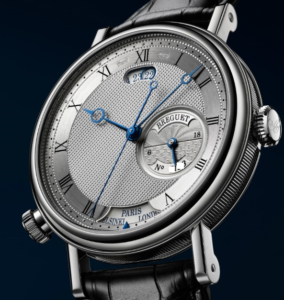
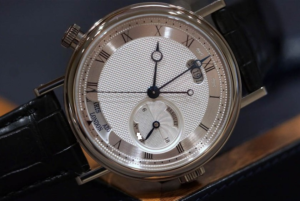
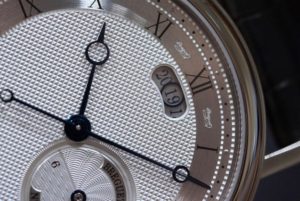
Breguet is now introducing a new interpretation of this sensational and award winning timepiece: the Classique Hora Mundi 5727. In place of a depiction of the globe, the dial of this 2016 edition features a “clou de Paris” hobnailing motif entirely hand-crafted on a silvered gold dial.
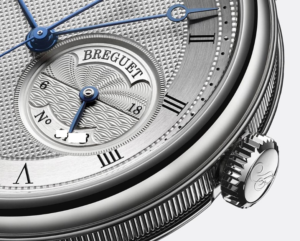
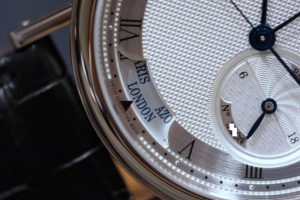
The 24-hour indicator located between 3 and 4 o’clock has been adorned with two different types of engine-turning. Its upper part is enhanced with a flame pattern and bears the Breguet inscription, while a cross weave motif graces the lower section stamped with the watch’s serial number.
With its single set of hours and minutes hands and no subdial, the Classique Hora Mundi is unlike other GMT or dual-time watches. This pair of hands is linked to a mechanical memory located beneath the dial and capable of keeping track of the time in two time zones allowing the wearer to adjust the time in two different places in the world, and to display one or the other on demand.
When the Hora Mundi switches from one memorised time to another, the date and the day/night or 24-hour indication, are simultaneously adjusted. All this takes place without disturbing the rate of the watch, whose precision is maintained during time-setting by means of a stop-seconds system.
The original date display is based on a dragging disc appearing through a 12 o’clock aperture able to reveal three successive dates at a time.
The legibility of the date is enhanced by a retrograde hand tipped by a protruding circle that frames the current date as soon as it appears in the left-hand part of the aperture and follows it throughout the day until it disappears to the right of the aperture.
At midnight, the hand bearing the circle jumps to return to the left-hand side of the aperture and frame the date of the new day that is beginning.
The case, available in rose or white gold – almost 1 mm slimmer than the 2011 version of the Classique Hora Mundi. The caseband with fluted sides and welded strap lugs are typical details of Breguet timepieces.
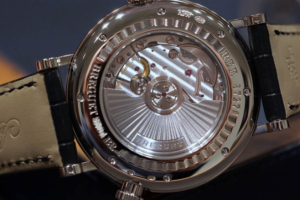
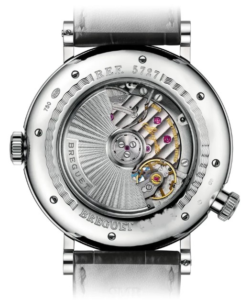
Classique”Hora Mundi”wristwatch in 18-carat white gold. Self-winding movement. Instant-jump time-zone display with synchronised date, day/night indication and city. Balance spring, lever and escape wheel in silicon. Dial in silvered gold, hand-engraved on a rose engine. Blued steel Breguet hands with “apple” tip. Minute markers around the outer rim. Roman numerals. Sapphire caseback. Water-resistant to 3 bar (30m). Diameter 43mm.